Spoon, knife or fork? The persimmon seed forecast and other lore of the ‘divine fruit’
Split a persimmon seed and a little white shape is said to tell the coming winter. Here is what it really is, why a persimmon doesn’t need a frost, and how a pucker-making fruit ended up in puddings, beer and golf clubs.
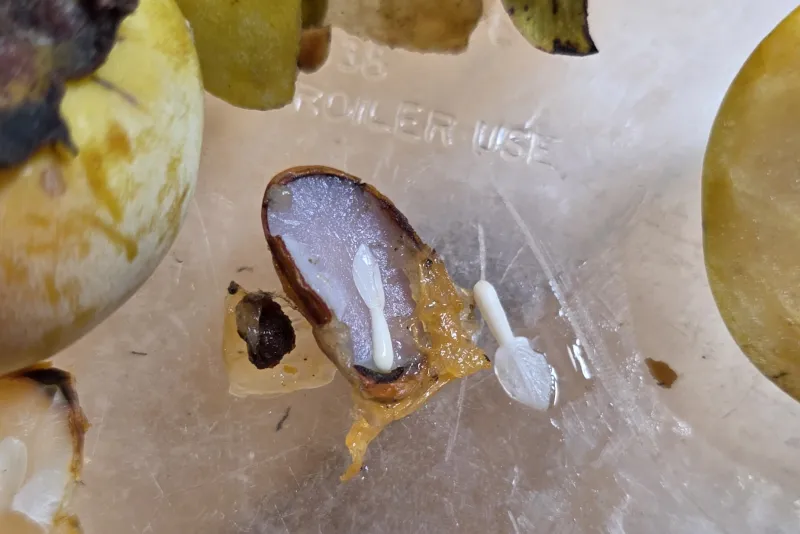
FAYETTEVILLE, Ark. — Split a persimmon seed in the fall and a small white shape appears inside. Folks have long read the coming winter in it: a spoon means a lot of snow, a fork means a mild winter and a knife means a very cold one, University of Missouri Extension says. In a longer version recorded by Purdue Extension, the spoon means deep snow to shovel, the knife means icy, cutting winds, and the fork means a mild winter with plenty to eat until spring.
Seeds an NWA News editor split from green persimmons this September showed spoons, and so did a batch from October 2024. Both came from the same tree near Sonora, a small community in Washington County close to the White River, one of only two trees the editor could find carrying fruit this year. They are in good company: in 2016, Missouri State University’s Fruit Experiment Station at Mountain Grove split its own and found “they all had spoons inside.”
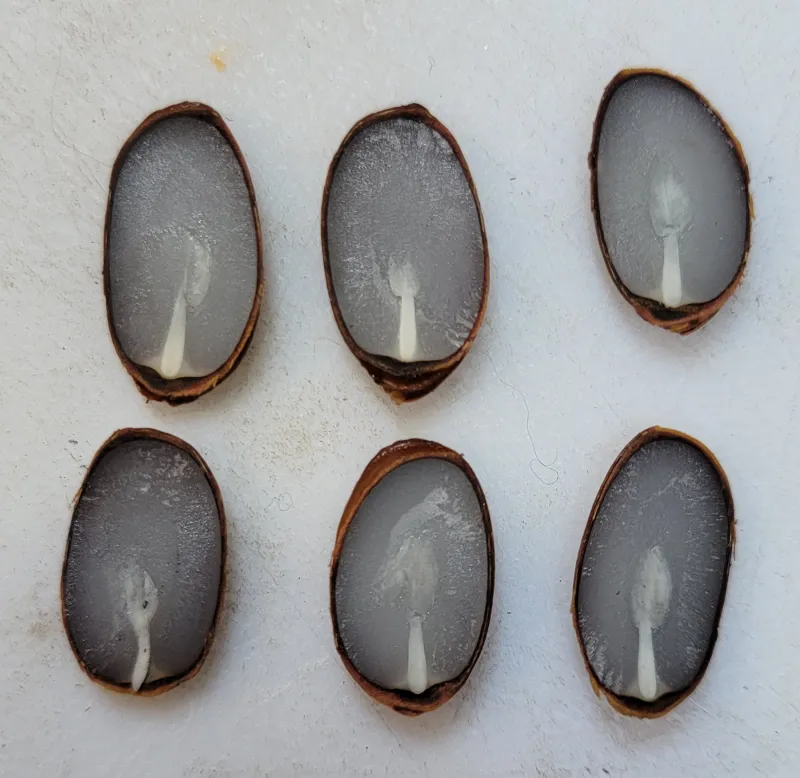
The shape is part of the seed’s embryo, the cotyledons that become a seedling’s first leaves in spring, the Farmers’ Almanac explains. As a forecast, it has no scientific backing. “As with most folklore, the predictive power of persimmon seeds lacks scientific backing,” MU Extension says, and even the Almanac allows that botanists are skeptical. For anyone who wants to try anyway, the Almanac says to use ripe fruit, because a hard, astringent persimmon’s seed will not split cleanly.
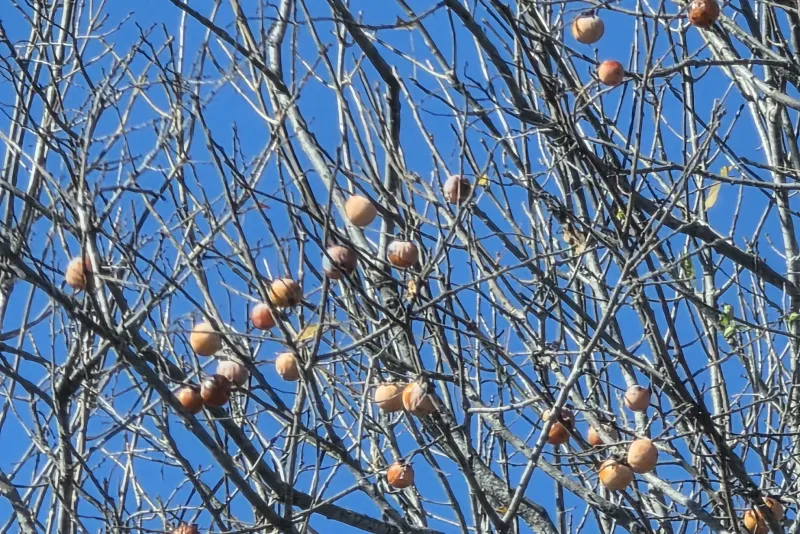
Another bit of lore holds that a persimmon isn’t fit to eat until after a frost. It isn’t so. “Contrary to popular belief, the fruit does not have to experience a frost to ripen,” Lenny Farlee of Purdue Extension wrote. The pucker comes from tannins in unripe fruit, and losing them “is a function of time, not temperature,” University of Missouri horticulturist David Trinklein wrote. Freezing does not change it. The fruit simply ripens so late that it is often called “first-frost fruit,” MU Extension says.
Anyone who has bitten an unripe one knows the feeling, and so did Captain John Smith. In 1612 he wrote of the Virginia fruit: “if it be not ripe it will drawe a mans mouth awrie with much torment; but when it is ripe, it is as delicious as an Apricock.”
The name itself comes from the Algonquian word written down as “putchamin,” Trinklein wrote. The scientific name, Diospyros, loosely means “divine fruit” or “fruit of the gods,” according to Purdue. The tree belongs to the ebony family, and its wood is hard enough that it was prized for textile shuttles and the heads of golf club drivers, the old “persimmon woods,” according to the USDA and the U.S. Forest Service.
Native people dried the sugary fruit for winter and used it in puddings and breads, and used the inner bark to treat mouth and throat ailments, according to the Missouri Department of Conservation. During the Civil War, the seeds were used as buttons and were roasted and ground as a coffee substitute. The fruit was made into wine and beer, the beer nicknamed “possum toddy,” and one of the tree’s old names is possumwood.

A ripe persimmon is about 15% sugar, MU Extension says. The Missouri Department of Conservation’s advice is to pick orange ones that are soft and mushy, and the easiest harvest is whatever has fallen to the ground. The fruit goes into puddings, cookies, cakes, custard and sherbet, according to the USDA. Wildlife gets most of it first.
One caution comes with the folklore: unripe fruit is not just unpleasant. Its tannin “can combine with other stomach contents to form what is called a phytobezoar,” a mass that can block the stomach, Purdue Extension warns. Wait for soft fruit.
Spotted a mistake? Tell us. We fix errors in the open, on the corrections page.