Fall is shooting-star season. Here’s why, and the best nights left in 2026
The year’s best meteor shower, the Geminids, peaks Dec. 13–14 under a mostly dark sky, and the speedy Leonids come first. Where meteors come from, why the hours before dawn bring the most, and how to watch from the Ozarks.
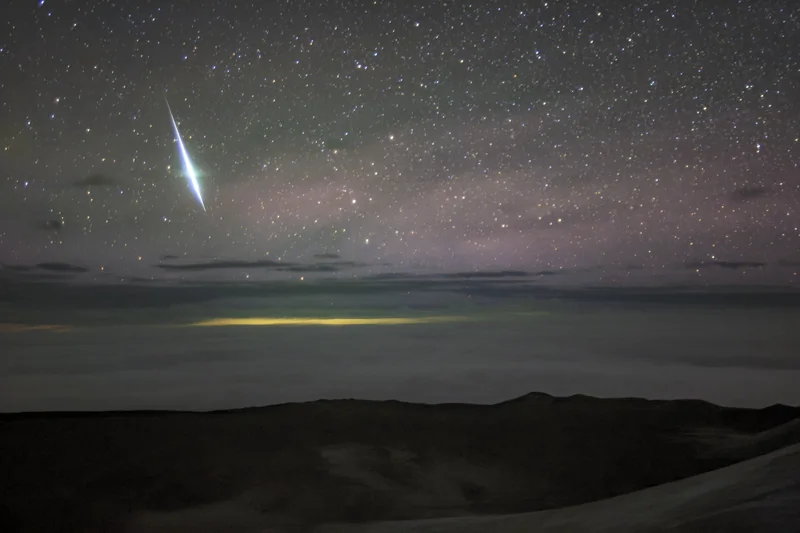
FAYETTEVILLE, Ark. — If you have ever stepped outside before dawn on a fall morning and caught a streak of light, it was not just luck. The second half of the year is the busiest stretch for meteors in the Northern Hemisphere, and the best show of 2026 is still ahead: the Geminids, which peak the night of Dec. 13–14 with a thin crescent moon that sets at 9:16 p.m. in Fayetteville, according to U.S. Naval Observatory tables.
ActivePeakRates are for a dark country sky with the shower high overhead; most people see fewer.
Two chances come sooner. The Northern Taurids, a thin shower known for slow, bright fireballs, are near their broad peak now, under a moon that sets early in the evening. The Leonids, the fastest meteors of the year, peak the night of Nov. 16–17. The moon sets at 11:25 p.m. that night, leaving the best hours, after midnight, dark.
Why fall? Part of it is the lineup of showers: the Orionids in October, then the Taurids, Leonids and Geminids in November and December. But even ordinary “sporadic” meteors, the random ones that belong to no shower, follow a yearly cycle. In the Northern Hemisphere they peak between July and December and hit bottom in spring, according to the observing guide of the Association of Lunar and Planetary Observers’ meteors section. At the high point, a watcher under a dark country sky can expect about 15 in the last hour before morning twilight, the guide says; near the spring low, as few as five.
- Before dawn, the front windshield. Your side of Earth faces the way the planet is moving and runs into space dust, so it catches the most meteors.
- In the evening, the rear window. Dust has to catch up from behind. At midnight you see about a quarter as many meteors as in the last dark hour before dawn.
The hour matters even more than the month. The guide compares the evening sky to the rear window of a car driving through rain. In the evening you are facing the direction Earth is leaving behind, so a meteor has to catch up with the planet to hit the air above you. After midnight your side of the planet turns to face forward, into the dust. At midnight, the guide says, you may see only about a quarter as many meteors as in the last dark hour before dawn, and rates climb sharply after 2 a.m.
What you are seeing is a speck of space debris, most no bigger than a grain of sand, hitting the upper atmosphere so fast that it burns up about 50 miles above the ground, according to NASA. NASA calls the bits in space meteoroids, the streak of light a meteor and any piece that reaches the ground a meteorite. A meteor brighter than the planet Venus is called a fireball.
- The comet sheds dust and grit each time it swings past the sun, and the debris spreads out along its whole path.
- Earth crosses that path on about the same date every year. That night is the shower’s peak.
Showers come from comets. Each time a comet swings in close to the sun, it sheds dust and grit. Over many trips that debris spreads along the comet’s path, and where the path crosses Earth’s orbit, Earth runs through the dust on about the same date every year. Seen from the ground, the meteors seem to fly out of one spot in the sky, called the radiant, and the shower is named for the constellation there: the Leonids for Leo, the Geminids for Gemini.
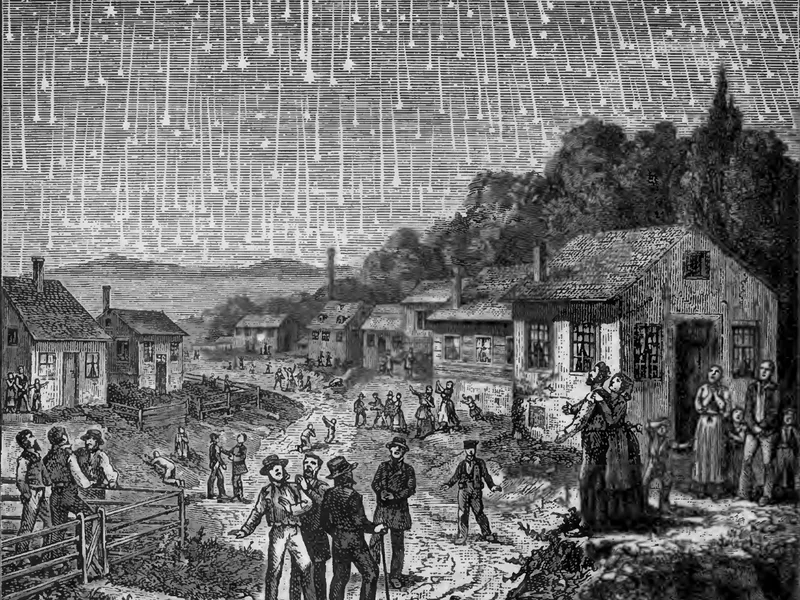
The Leonids come from comet 55P/Tempel-Tuttle, which takes 33 years to go around the sun. NASA says that is why the Leonids can produce great storms every 33 years or so, when the comet has just passed and its fresh dust is thick. The Geminids are the odd ones. Their parent, 3200 Phaethon, does not grow a tail when it nears the sun, and its light looks like a rocky asteroid’s, NASA says. It was discovered in 1983 and is about 3 miles across. Halley’s comet, last seen in 1986, feeds two showers, the Orionids in October and the Eta Aquariids in May.
The speeds are hard to picture. Leonids hit the air at 44 miles a second, according to NASA, fast enough to cross Arkansas from east to west in about six seconds. Geminids are slower, at about 22 miles a second, and the Northern Taurids slower still, at about 18 miles a second. Scientists estimate that about 48.5 tons of material from space falls on Earth every day, NASA says.
Big ones do pass over the Ozarks. On the evening of June 14, people in a dozen states, including Arkansas, reported a fireball that blazed 16 times brighter than Venus, according to the American Meteor Society. It was first seen 60 miles above Tupelo, Miss., moving about 56,000 mph, and broke apart 34 miles above Missouri’s Mark Twain National Forest. It was only about 3 inches across and left no meteorites, the society said.
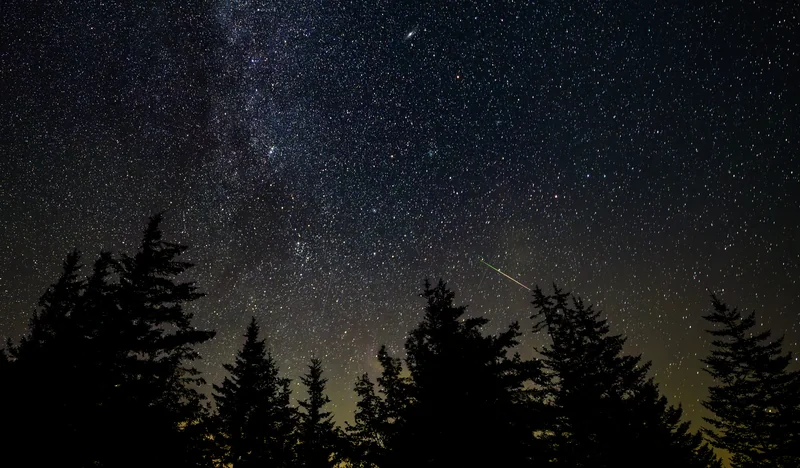
The Geminids are the easiest major shower for most people to catch, because they start early. “This is the one major shower that provides good activity before midnight,” the American Meteor Society says, with Gemini well up by 10 p.m. NASA says up to 120 Geminids an hour can be seen at the peak under perfect conditions. Most people see far fewer, because few places are that dark, but the best rates of the year may come between 1 and 2 a.m. on Dec. 14, when the radiant is nearly overhead, according to the observers’ guide.
Watching takes no equipment, NASA’s Jet Propulsion Laboratory says. Find the darkest sky you can, lie back and take in as much of the sky as possible. “Let your eyes hang loose and don’t look in any one specific spot,” JPL advises. Put away the phone, which spoils night vision, and use a red light if you need one. Leave the telescope and binoculars at home, and plan to watch for at least half an hour. You do not have to face the radiant; meteors can appear anywhere overhead.
Dark skies are not hard to find in this part of the state. Buffalo National River became Arkansas’ first International Dark Sky Park in 2019, according to the National Park Service, and rangers lead night-sky programs at Buffalo Point and Tyler Bend in the summer. Even a pasture or a gravel road away from town lights will show far more than a backyard under a streetlight.
If you see a fireball, the American Meteor Society collects reports from the public. Its witnesses help scientists work out where a space rock came from and, sometimes, where pieces may have landed. That is how meteorites have been found in Arkansas, including one that fell at Fayetteville in 1934.
Spotted a mistake? Tell us. We fix errors in the open, on the corrections page.