When does it usually snow first in Northwest Arkansas? Just before Christmas, but the last three winters waited until January
Station records for Fayetteville’s Drake Field go back to 1949. They show the first measurable snow has come as early as late October, as late as April, and some winters not at all.

FAYETTEVILLE, Ark. — In a typical winter, Fayetteville gets its first measurable snow, at least a tenth of an inch, around Dec. 23. That is the middle date for the 30 winters from 1991 to 2020 at Drake Field, according to an NWA News review of NOAA station records: in half of those winters the first snow came earlier, and in half it came later or not at all.
First measurable snow at Drake Field
First day with 0.1 inch of snow or moreNormal: Dec. 23 (middle date, 1991–2020)
Few winters follow the average. In three of the last eight, the first snow came in November: on Nov. 12, 2018, Nov. 11, 2019, and Nov. 11, 2022. The last three waited until January. The first measurable snow at Drake Field came Jan. 5 in both 2024 and 2025, and Jan. 24 this year.
The records stretch further at both ends. The earliest first snow at Drake Field, in records going back to 1949, was 0.3 inch on Oct. 29, 1993. In the winter of 1956–57, the first measurable snow did not fall until April 12, 1957, when an inch came down. And twice in the last 20 years, in the winters of 2006–07 and 2015–16, Drake Field never recorded a tenth of an inch at all.
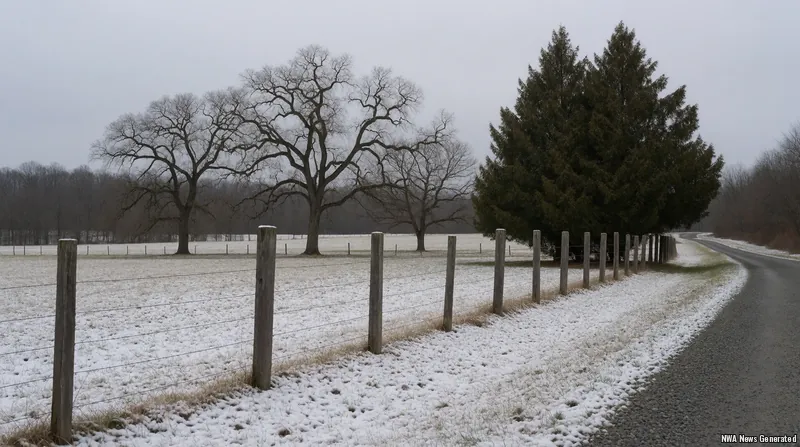
A snow big enough to cover the grass usually takes longer. Over 1991 to 2020, the first day with an inch or more came around Jan. 30 in a typical winter, and in nine of those 30 winters no single day brought an inch. That includes the winters of 2018–19 and 2019–20, which got their first snow in November but never an inch in one day.
February is Fayetteville’s snowiest month
Bars: snowfall in a normal year, in inches (6.5 inches for the whole winter).Bottom: how many of the 30 winters from 1991 to 2020 had at least 0.1 inch that month.
Most of the snow that does fall comes after the new year. In NOAA’s 1991–2020 climate normals, Drake Field averages 6.5 inches of snow a winter: 0.2 inch in November, 1.1 inches in December, 1.5 in January, 2.4 in February and 1.3 in March. Only six of those 30 winters had measurable snow in November, while 18 had some in February.
Some winters make up for the rest. The winter of 2009–10 brought 33 inches to Drake Field, the most in the station’s records, starting with a Christmas Eve snow. The most in a single day was 14.6 inches on Feb. 9, 2011.
This winter has not started yet: Drake Field had recorded no snow as of mid-November. For what forecasters expect over the coming months, see NWA News’ look at the winter outlook.
Spotted a mistake? Tell us. We fix errors in the open, on the corrections page.