Purple dogwoods and a carpet of oak leaves: what makes Ozark trees change color
Fall color is a tree packing up for winter. Longer nights start it, sunshine and cool nights paint the reds, and drought, rain and a hard freeze can speed it up or wash it out. Here is what is happening inside the leaves, tree by tree.
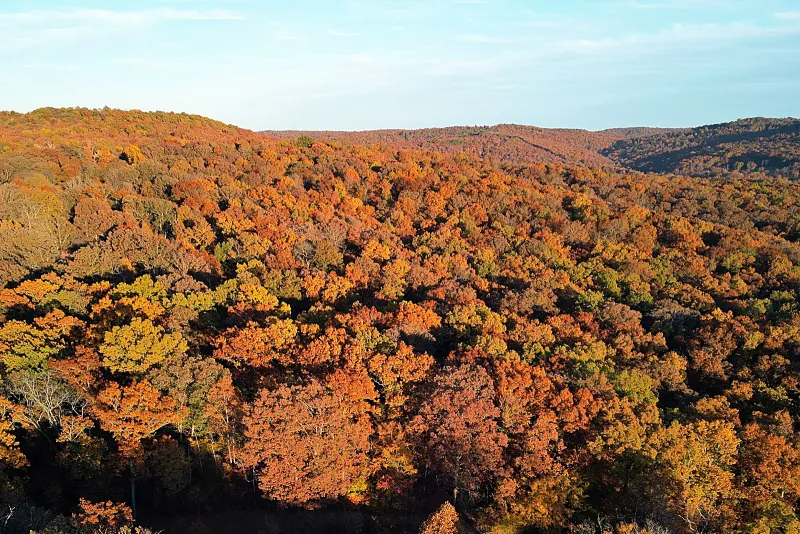
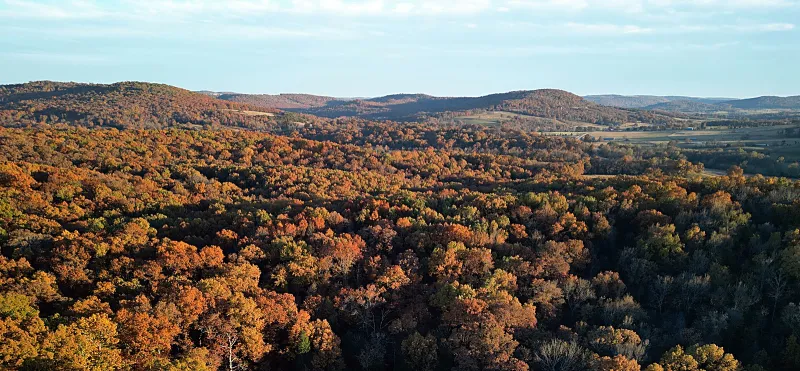
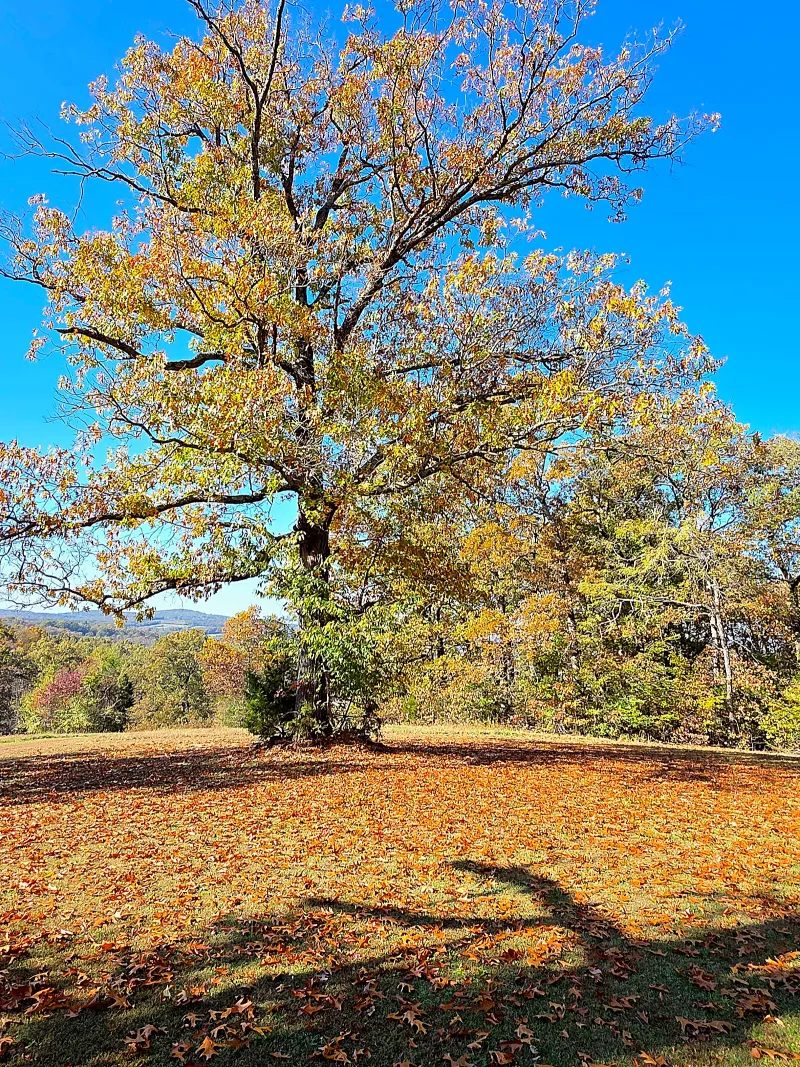
HUNTSVILLE, Ark. — By Wednesday morning, the oaks on one Northwest Arkansas hillside had let go of most of their leaves. They lay in a copper layer across the grass, curled and crisp, while a flowering dogwood at the edge of the woods still held a crown of deep purple-red. Overhead, hickories and oaks mixed gold, orange and green against a clear sky.
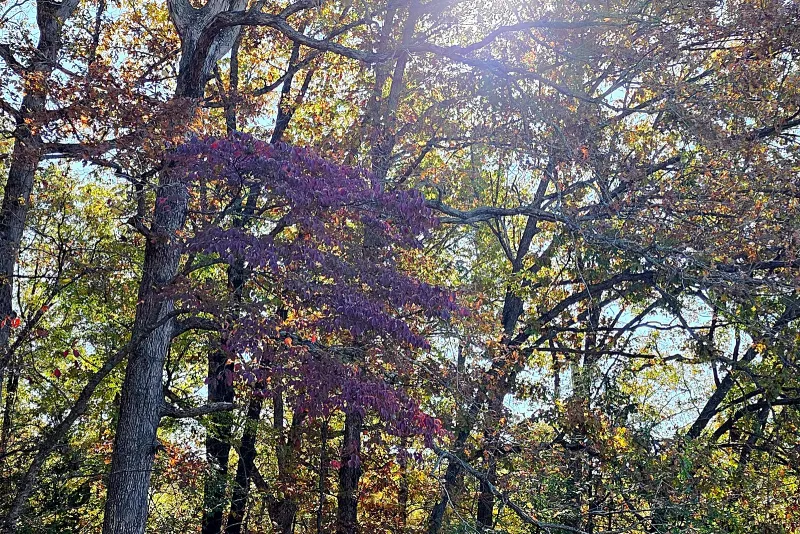
Those colors aren’t paint added in the fall. Most of them were there all along, or are made at the last minute as a tree shuts down its leaves for winter, according to forestry and extension scientists. Which colors show up, and when, depends on the kind of tree, the weather of the last few weeks and, this year, a long drought.
The green in a summer leaf is chlorophyll, the pigment that captures sunlight to make sugar. Sunlight also wears chlorophyll out, so a healthy leaf has to keep making new chlorophyll all season, Purdue University tree physiologist William Chaney wrote in an extension guide to fall color.
In late summer the nights get longer, and that is the signal. The timing of fall color is set mainly by the calendar, by the length of the night, the U.S. Forest Service says; weather mostly changes how bright it gets. As nights lengthen, the tree slowly pulls nitrogen and phosphorus out of its leaves and stores them in its twigs and branches for next spring, Chaney wrote. Without those nutrients, the leaf stops making chlorophyll, and the green fades.
What’s left underneath is yellow and orange. Those pigments, carotenoids, are in the leaf from the day it opens, helping catch light, but they are hidden by green most of the year. They are why hickories, ashes, sycamores and tulip trees turn yellow, Chaney wrote. The same pigment family colors carrots.
Reds and purples are different. They come from anthocyanins, the pigments in red apples, grapes and blueberries, and most trees make them only in the fall. As the leaf shuts down, a layer of cells at the base of the leaf stem, called the abscission layer, closes off the path that carries sugar out of the leaf. The trapped sugar is turned into anthocyanins. That layer is also the line where the leaf will eventually break off and fall.
That explains some of the patchwork on a hillside. A tree in full sun keeps making sugar and turns red, while the same kind of tree in the shade may turn only yellow, and one branch can be redder than another on the same tree, Chaney wrote. Anthocyanins are red when the sap in the leaf cells is acidic and can shift toward purple and blue as it grows less acidic, so reds vary from scarlet to plum. Some trees don’t have the genes to make anthocyanins at all, and turn only yellow and brown.

Sassafras Sassafras albidum
- orange
- scarlet
- yellow
One of the first to turn. Look for three leaf shapes on one tree: an oval, a mitten and a three-fingered leaf.
Where sassafras grows
Shaded: native range
Range. Sassafras grows from southwestern Maine west to southern Ontario and central Michigan, southwest through Illinois, Missouri, eastern Oklahoma and eastern Texas, and east to central Florida.
Where it does best. It grows on almost any soil but does best on moist, well-drained sandy loams; it is a pioneer of old fields, fencerows and dry ridges, especially after fire, and does not tolerate poorly drained soil.
In Arkansas. Statewide but a minor tree in Arkansas’s forests: the Forest Service’s 2020 survey of Arkansas forests tallied 334 sassafras in its statewide sample, 36th among hardwoods. In a 1995 Forest Service survey, about 59 percent of its wood volume was in the Ozark region.
Learn more: Forest Service Fire Effects Information System · Silvics of North America (Forest Service) · Arkansas’s Forests, 2020 (Forest Service) · Forest Resources of Arkansas, 1995 (Forest Service)
Range maps: Elbert L. Little Jr., Atlas of United States Trees (U.S. Forest Service), digitized by the U.S. Geological Survey. They show the general native range; trees are also planted outside it.
Sumac Rhus species
- red
The red along road cuts and field edges in September. Pictured: winged sumac.
Where sumac grows
Shaded: native range (winged sumac)
Range. Winged sumac ranges from southwestern Maine down the Coastal Plain to southern Florida and west to eastern Texas, and inland from central Michigan and Wisconsin to southeastern Iowa, southeastern Kansas and Oklahoma. Smooth sumac grows across most of the lower 48 states, except California, and into Mexico and southern Canada.
Where it does best. Both are sun-loving thicket shrubs of fields, fencerows, roadsides and woods edges; winged sumac does best on well-drained, slightly acid soils, and smooth sumac often forms dense thickets on dry prairie and rocky hillsides.
In Arkansas. Winged and smooth sumac are the two most commonly seen sumacs in Arkansas and grow in every county, often in colonies along roadsides, according to the UA Cooperative Extension Service. They are shrubs, so the state’s forest surveys do not count them.
Learn more: Forest Service Fire Effects Information System · Forest Service Fire Effects Information System (smooth sumac) · UA Cooperative Extension: Sumacs aflame in the fall · Missouri Department of Conservation field guide
Range maps: Elbert L. Little Jr., Atlas of United States Trees (U.S. Forest Service), digitized by the U.S. Geological Survey. They show the general native range; trees are also planted outside it.
Flowering dogwood Cornus florida
- scarlet
- purple-red
Often the first red in the understory. Its reds can lean purple: the same pigment shifts from red toward purple as the sap in the leaf cells grows less acidic.
Where flowering dogwood grows
Shaded: native range
Range. Flowering dogwood grows from southwestern Maine to central Florida and west through southern Ontario, Michigan and Illinois to Missouri, southeastern Kansas, eastern Oklahoma and eastern Texas. A variety grows in the mountains of eastern Mexico.
Where it does best. It is an understory tree of moist hardwood woods, slopes, bluffs and ravines and grows poorly on dry ridgetops.
In Arkansas. Found statewide but most at home in the north: in a 1995 Forest Service survey, about 62 percent of Arkansas’s dogwood wood volume was in the 24-county Ozark region. It is a small tree, so it ranks low on volume; the Forest Service’s 2020 survey of Arkansas forests counted 659 dogwoods in its statewide field sample, 22nd among hardwoods.
Learn more: Forest Service Fire Effects Information System · Silvics of North America (Forest Service) · Forest Resources of Arkansas, 1995 (Forest Service) · Arkansas’s Forests, 2020 (Forest Service)
Range maps: Elbert L. Little Jr., Atlas of United States Trees (U.S. Forest Service), digitized by the U.S. Geological Survey. They show the general native range; trees are also planted outside it.
Black gum Nyssa sylvatica
- scarlet
Glossy leaves that a Missouri Department of Conservation forester compared to flattened rubies. Its small blue fruits feed birds.
Where black gum grows
Shaded: native range
Range. Blackgum grows from southern Ontario and southwestern Maine south to central Florida and west across the eastern United States, with scattered stands in central and southern Mexico.
Where it does best. It takes a wide range of sites, from creek bottoms that flood briefly in spring to dry upper slopes, though it grows slowly on dry uplands.
In Arkansas. Common across Arkansas: the Forest Service’s 2020 survey of Arkansas forests ranked it the eighth most-tallied hardwood in its statewide sample (2,415 trees) and 13th among hardwoods by volume. In a 1995 Forest Service survey, its volume was split mainly between the Ozark region (about 43 percent) and the southwest Coastal Plain (about 35 percent).
Learn more: Forest Service Fire Effects Information System · Arkansas’s Forests, 2020 (Forest Service) · Forest Resources of Arkansas, 1995 (Forest Service)
Range maps: Elbert L. Little Jr., Atlas of United States Trees (U.S. Forest Service), digitized by the U.S. Geological Survey. They show the general native range; trees are also planted outside it.
White ash Fraxinus americana
- gold
- maroon
- plum
The compound leaves start golden and can deepen to maroon and plum, so ash trees often show purple from a distance. Green ash, more common statewide, turns plain yellow.
Where white ash grows
Shaded: native range
Range. White ash grows from Cape Breton Island, Nova Scotia, south to northern Florida and west to eastern Minnesota and eastern Texas.
Where it does best. It needs fertile, moist, well-drained soils, often over limestone, and tends to grow on drier sites than green ash.
In Arkansas. White ash is mostly a northern Arkansas tree: a 1995 Forest Service survey put 65 percent of its volume in the Ozark region. The Forest Service’s 2020 survey of Arkansas forests tallied 588 white ashes and 1,395 green ashes, a bottomland tree with only 9 percent of its 1995 volume in the Ozarks. The same report noted the emerald ash borer, an invasive beetle that kills ash trees, had been found in 25 Arkansas counties.
Learn more: Silvics of North America (Forest Service): White Ash · Silvics of North America (Forest Service): Green Ash · Missouri Department of Conservation: White Ash · Missouri Department of Conservation: Green Ash · UA Cooperative Extension, Plant of the Week: White Ash · NC State Extension Gardener Plant Toolbox: Fraxinus americana · Forest Resources of Arkansas, 1995 (Forest Service) · Arkansas’s Forests, 2020 (Forest Service)
Range maps: Elbert L. Little Jr., Atlas of United States Trees (U.S. Forest Service), digitized by the U.S. Geological Survey. They show the general native range; trees are also planted outside it.
Sweetgum Liquidambar styraciflua
- yellow
- red
- burgundy
Star-shaped leaves, and some of the widest color on one tree, from yellow to deep purple. The spiky balls are its seed pods.
Where sweetgum grows
Shaded: native range
Range. Sweetgum grows from Connecticut south to central Florida and eastern Texas, west to Missouri, Arkansas and Oklahoma and north to southern Illinois. Scattered stands also grow in Mexico and Central America.
Where it does best. It tolerates many soils but grows best on rich, moist clay and loam soils of river bottoms.
In Arkansas. One of Arkansas’s most common hardwoods, but mostly a southern and lowland tree here. The Forest Service’s 2020 survey of Arkansas forests counted more sweetgums than any other hardwood and ranked it second to white oak in hardwood volume, about 10 percent. A 1995 Forest Service survey found it strongest on the Coastal Plain and in the Delta, with about 60 percent of its wood in southwest Arkansas, and said it “becomes noticeably absent on the Ozark Plateaus in the northwest portion of the State.” The federal range map above leaves Fayetteville, Bentonville and Harrison outside its native range.
Learn more: Forest Service Fire Effects Information System · Silvics of North America (Forest Service) · Arkansas’s Forests, 2020 (Forest Service) · Forest Resources of Arkansas, 1995 (Forest Service) · Missouri Department of Conservation field guide
Range maps: Elbert L. Little Jr., Atlas of United States Trees (U.S. Forest Service), digitized by the U.S. Geological Survey. They show the general native range; trees are also planted outside it.
Hickories Carya species
- golden yellow
- bronze
The gold in Ozark hillsides. Hickories don’t make much red: their yellow was in the leaf all summer, hidden by green.
Where hickories grow
Shaded: native range (black, mockernut and shagbark hickory together)
Range. Shagbark hickory grows across most of the eastern United States, from southeastern Nebraska and Minnesota to Maine and south to Georgia and eastern Texas, but is largely absent from the Gulf Coastal Plain and lower Mississippi Delta. Mockernut hickory grows from Massachusetts to eastern Kansas and south to eastern Texas and northern Florida.
Where it does best. Mockernut and black hickory favor dry upland slopes and ridges; shagbark grows on uplands in the North but mostly in river bottoms and coves in the South.
In Arkansas. Hickories are a major part of Arkansas’s oak-hickory forests: the hickory group holds about 2.3 billion cubic feet of wood, roughly 10 percent of the state’s hardwood volume, led by black hickory and mockernut (Forest Service, 2020). Black hickory, the most common, is concentrated in the Ozarks, which held about 73 percent of its volume in a 1995 Forest Service survey. In northern Arkansas, shagbark is often very common on clay soils weathered from shale.
Learn more: Forest Service Fire Effects Information System (shagbark) · Forest Service Fire Effects Information System (mockernut) · Silvics of North America (Forest Service, shagbark) · Silvics of North America (Forest Service, mockernut) · Arkansas’s Forests, 2020 (Forest Service) · Forest Resources of Arkansas, 1995 (Forest Service)
Range maps: Elbert L. Little Jr., Atlas of United States Trees (U.S. Forest Service), digitized by the U.S. Geological Survey. They show the general native range; trees are also planted outside it.
Southern sugar maple Acer floridanum
- yellow
- orange
- red
A smaller cousin of sugar maple, with leaves 1¼ to 4 inches long, blunt or rounded lobes and smooth, light gray bark like a beech’s. NC State Extension calls its fall color spectacular in orange, red and yellow.
Where southern sugar maple grows
Shaded: native range
Range. Southern sugar maple grows from southeastern Virginia through the Carolinas and Georgia to the Florida Panhandle, west across the Gulf states to eastern Texas, and north across Arkansas into eastern Oklahoma; Missouri is at the edge of its range.
Where it does best. It grows in the understory on fertile, moist, well-drained soils of stream terraces, coves and bluffs, best over limestone.
In Arkansas. The Forest Service’s 2020 survey of Arkansas forests tallied 613 southern (Florida) sugar maples, against just 26 sugar maples. In a 1995 Forest Service survey, 65 percent of its volume was in the Ozark region.
Learn more: Silvics of North America (Forest Service): Florida Maple · Missouri Department of Conservation: Sugar Maple (southern sugar maple subspecies) · UA Cooperative Extension, Plant of the Week: Sugar Maple · NC State Extension Gardener Plant Toolbox: Acer floridanum · Forest Resources of Arkansas, 1995 (Forest Service) · Arkansas’s Forests, 2020 (Forest Service)
Range maps: Elbert L. Little Jr., Atlas of United States Trees (U.S. Forest Service), digitized by the U.S. Geological Survey. They show the general native range; trees are also planted outside it.
Common persimmon Diospyros virginiana
- yellow
- yellow-brown
- reddish purple
Leaf color is unreliable, from yellow-brown to reddish purple, but the fruit steals the show, turning orange and sweet after frost. Look for dark, blocky bark that resembles alligator hide.
Where common persimmon grows
Shaded: native range
Range. Common persimmon grows from southern Connecticut and Long Island to southern Florida, west to central Illinois and southeast Iowa, and south through eastern Kansas and Oklahoma to central Texas.
Where it does best. It grows almost anywhere, from dry, sandy woods, rocky hillsides and old fields to river bottoms, where it reaches its best size.
In Arkansas. Persimmon grows statewide: the Forest Service’s 2020 survey of Arkansas forests tallied 581 in its field sample, and a 1995 Forest Service survey found its volume spread across every region, 31 percent in the Ozarks. In 1541, Hernando de Soto’s expedition found persimmon bread at Casqui, the village now preserved at Parkin Archeological State Park.
Learn more: Silvics of North America (Forest Service): Common Persimmon · Forest Service Fire Effects Information System: Diospyros virginiana · Missouri Department of Conservation: Persimmon · UA Cooperative Extension, Plant of the Week: Persimmon · NC State Extension Gardener Plant Toolbox: Diospyros virginiana · Forest Resources of Arkansas, 1995 (Forest Service) · Arkansas’s Forests, 2020 (Forest Service)
Range maps: Elbert L. Little Jr., Atlas of United States Trees (U.S. Forest Service), digitized by the U.S. Geological Survey. They show the general native range; trees are also planted outside it.
Red maple Acer rubrum
- scarlet
- orange
- yellow
Arkansas’s most common maple has something red in every season: flowers in late winter, leafstalks in summer and scarlet to orange leaves in fall. Look for V-shaped notches between the leaf lobes and whitish leaf undersides.
Where red maple grows
Shaded: native range
Range. Red maple is one of the most abundant and widespread trees in eastern North America, growing from Newfoundland and southern Quebec west to Minnesota and south to eastern Oklahoma, eastern Texas and Florida.
Where it does best. It grows almost anywhere, from swamps, stream edges and bottomland forests to dry upland woods and bluffs.
In Arkansas. Red maple grows statewide and is Arkansas’s most common maple: the Forest Service’s 2020 survey of Arkansas forests tallied 2,476 in its field sample, seventh among hardwoods. A 1995 Forest Service survey put about a quarter of the state’s red maple wood volume in the 24-county Ozark region and nearly half in the southwest. True sugar maple is scarce here, with just 26 tallied in 2020; the more common look-alike is the smaller-leaved southern, or Florida, sugar maple, with 613.
Learn more: Silvics of North America (Forest Service): Red Maple · Missouri Department of Conservation: Red Maple · Silvics of North America (Forest Service): Florida Maple · Missouri Department of Conservation: Sugar Maple (southern sugar maple subspecies) · UA Cooperative Extension, Plant of the Week: Sugar Maple · UA Cooperative Extension, Plant of the Week: Fall Color (2012) · NC State Extension Gardener Plant Toolbox: Acer rubrum · Forest Resources of Arkansas, 1995 (Forest Service) · Arkansas’s Forests, 2020 (Forest Service)
Range maps: Elbert L. Little Jr., Atlas of United States Trees (U.S. Forest Service), digitized by the U.S. Geological Survey. They show the general native range; trees are also planted outside it.
Eastern redbud Cercis canadensis
- yellow
- greenish yellow
Better known for pink spring flowers, redbud turns its heart-shaped leaves yellow or greenish yellow in fall. Its flat, leathery seedpods often hang on all winter.
Where eastern redbud grows
Shaded: native range
Range. Eastern redbud grows from New Jersey and southern Pennsylvania northwest to southern Michigan, southwest to southeastern Nebraska, south to central Texas and east to central Florida.
Where it does best. It is an understory tree of open woods, woodland edges, glades and rocky streamsides, most common on south-facing slopes, and it cannot tolerate flooded ground.
In Arkansas. Redbud is small, so it ranks low in timber surveys, but it is concentrated in the north: a 1995 Forest Service survey put 69 percent of its volume in the Ozark region. The Forest Service’s 2020 survey of Arkansas forests tallied 297. In the Ozarks it is usually in full bloom by mid-April.
Learn more: Silvics of North America (Forest Service): Eastern Redbud · Forest Service Fire Effects Information System: Cercis canadensis · Missouri Department of Conservation: Eastern Redbud · UA Cooperative Extension, Plant of the Week: Redbud · NC State Extension Gardener Plant Toolbox: Cercis canadensis · Forest Resources of Arkansas, 1995 (Forest Service) · Arkansas’s Forests, 2020 (Forest Service)
Range maps: Elbert L. Little Jr., Atlas of United States Trees (U.S. Forest Service), digitized by the U.S. Geological Survey. They show the general native range; trees are also planted outside it.
Red oaks Quercus rubra, velutina and falcata
- russet red
- bronze
- brown
Red oaks have bristle tips on their pointed lobes; white oaks have rounded lobes. Northern red oak can turn brownish red to scarlet, while black and southern red oaks are usually duller, russet to brown.
Where red oaks grow
Shaded: native range (northern red, black and southern red oak together)
Range. Northern red oak grows from Nova Scotia to Minnesota and south to Arkansas, Alabama and Georgia; black oak from southern Maine to Minnesota and south to east Texas and northwest Florida. Southern red oak is a Southern tree, from Long Island to north Florida and west to Texas, reaching north into Arkansas, southern Missouri and southern Illinois.
Where it does best. Northern red oak favors moist ravines and north- and east-facing slopes, black oak dry, rocky ridges, and southern red oak dry sandy or clay uplands.
In Arkansas. Together they are a backbone of Arkansas hardwood forests: the Forest Service’s 2020 survey of Arkansas forests tallied 1,749 southern red oaks, 1,672 northern red oaks and 1,671 black oaks, and all three rank in the state’s top eight trees by wood volume. A 1995 Forest Service survey put 74 percent of the state’s northern red oak volume and 84 percent of its black oak in the Ozark region, with the heaviest concentrations in the Boston Mountains; southern red oak was spread statewide, with its largest share in the southwest.
Learn more: Silvics of North America (Forest Service): Northern Red Oak · Silvics of North America (Forest Service): Black Oak · Silvics of North America (Forest Service): Southern Red Oak · Missouri Department of Conservation: Northern Red Oak · Missouri Department of Conservation: Black Oak · Missouri Department of Conservation: Southern Red Oak (Spanish Oak) · NC State Extension Gardener Plant Toolbox: Quercus rubra · NC State Extension Gardener Plant Toolbox: Quercus velutina · NC State Extension Gardener Plant Toolbox: Quercus falcata · UA Cooperative Extension, Plant of the Week: Fall Color (2012) · Forest Resources of Arkansas, 1995 (Forest Service) · Arkansas’s Forests, 2020 (Forest Service)
Range maps: Elbert L. Little Jr., Atlas of United States Trees (U.S. Forest Service), digitized by the U.S. Geological Survey. They show the general native range; trees are also planted outside it.
Post oak Quercus stellata
- brown
- dull yellow
Its thick, leathery leaves have two squarish middle lobes that form a rough cross. Fall color is mostly brown to dull yellow, and leaves may hang on into winter.
Where post oak grows
Shaded: native range
Range. Post oak grows from southeastern Massachusetts and Long Island west to Iowa and Missouri, south to eastern Kansas, western Oklahoma and central Texas, and east to central Florida. It forms pure stands in the Cross Timbers of Oklahoma and Texas.
Where it does best. It typically grows on dry sites: rocky ridges, upper slopes facing south or west, and thin, nutrient-poor soils.
In Arkansas. After white oak, post oak is Arkansas’s most common oak: the Forest Service’s 2020 survey of Arkansas forests tallied 4,593, third among hardwoods, and it ranks fifth among all trees in wood volume. A 1995 Forest Service survey put 53 percent of its volume in the Ozark region. Before the Civil War, open post oak groves led a stagecoach passenger to call Fayetteville a “prairie in the mountains.”
Learn more: Silvics of North America (Forest Service): Post Oak · Forest Service Fire Effects Information System: Quercus stellata · Missouri Department of Conservation: Post Oak · UA Cooperative Extension, Plant of the Week: Post Oak · NC State Extension Gardener Plant Toolbox: Quercus stellata · UA Cooperative Extension, Plant of the Week: Fall Color (2012) · Forest Resources of Arkansas, 1995 (Forest Service) · Arkansas’s Forests, 2020 (Forest Service)
Range maps: Elbert L. Little Jr., Atlas of United States Trees (U.S. Forest Service), digitized by the U.S. Geological Survey. They show the general native range; trees are also planted outside it.
White oak Quercus alba
- reddish purple
- russet
Oaks turn late and hold on. As the reds fade, tannins, the bitter compounds in tea, leave the brown.
Where white oak grows
Shaded: native range
Range. White oak grows across most of the eastern United States, from southwestern Maine and southern Quebec west to southeastern Minnesota and south to eastern Kansas, Oklahoma, Texas and northern Florida. It is generally absent from the high Appalachians and the lower Mississippi Delta.
Where it does best. It grows on everything from rich uplands and coves to dry, gravelly slopes, but avoids shallow-soiled ridgetops, poorly drained flats and very wet bottoms.
In Arkansas. Arkansas’s top hardwood: white oak holds more wood than any tree except loblolly and shortleaf pine, about 3.2 billion cubic feet or 14 percent of hardwood volume (Forest Service, 2020). It grows statewide but is heaviest in the Boston and Ouachita mountains, and it was the leading species by volume in the Ozark region in a 1995 Forest Service survey.
Learn more: Forest Service Fire Effects Information System · Silvics of North America (Forest Service) · Arkansas’s Forests, 2020 (Forest Service) · Forest Resources of Arkansas, 1995 (Forest Service)
Range maps: Elbert L. Little Jr., Atlas of United States Trees (U.S. Forest Service), digitized by the U.S. Geological Survey. They show the general native range; trees are also planted outside it.
Bald cypress Taxodium distichum
- rusty orange
- cinnamon brown
A conifer that drops its needles every fall. The flat, feathery needles turn rusty orange to cinnamon brown, then fall still attached to their small twigs.
Where bald cypress grows
Shaded: native range
Range. Bald cypress grows along the Atlantic Coastal Plain from southern Delaware to southern Florida and along the Gulf Coast to southeastern Texas, and up the Mississippi Valley to southeastern Oklahoma, southeastern Missouri, southern Illinois and southwestern Indiana.
Where it does best. It grows in swamps, sloughs and along slow rivers on saturated or seasonally flooded soils, and more than 90 percent of natural stands are below 100 feet in elevation.
In Arkansas. A lowland tree in Arkansas: a 1995 Forest Service survey put 59 percent of its volume in the North and South Delta regions and 31 percent in the southwest, with just 3 percent in the Ozarks. The Forest Service’s 2020 survey of Arkansas forests tallied 375 and ranked bald cypress 14th among all the state’s trees in wood volume.
Learn more: Silvics of North America (Forest Service): Baldcypress · Missouri Department of Conservation: Bald Cypress · UA Cooperative Extension, Plant of the Week: Bald Cypress · NC State Extension Gardener Plant Toolbox: Taxodium distichum · Forest Resources of Arkansas, 1995 (Forest Service) · Arkansas’s Forests, 2020 (Forest Service)
Range maps: Elbert L. Little Jr., Atlas of United States Trees (U.S. Forest Service), digitized by the U.S. Geological Survey. They show the general native range; trees are also planted outside it.Why a tree spends its last energy on red pigment is still debated. One leading idea, from a 2001 study of red-osier dogwood by Harvard researchers, is that the red works as a sunscreen, shading the weakened leaf so it can keep working long enough for the tree to pull nutrients back out before the leaf drops.
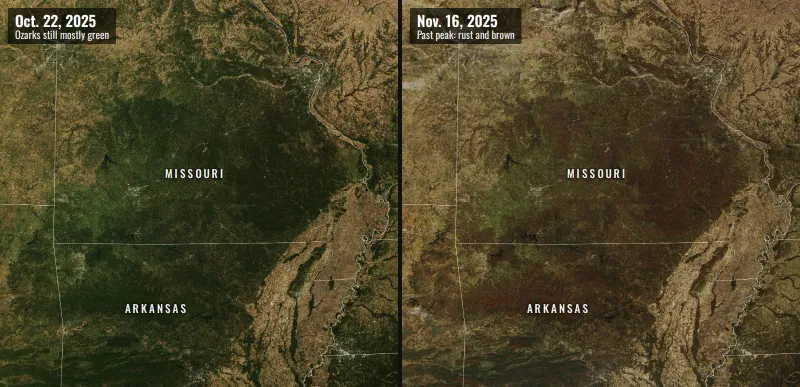
Brown is the last color. Tannins, the bitter compounds that flavor tea and make an unripe persimmon pucker your mouth, are always in the leaf and show once the other pigments break down, Chaney wrote. Oaks carry a lot of them, which is why Ozark oaks end the season in russet and leather brown, and why the oak leaves on the ground on Wednesday had already gone coppery. NASA satellite images of the Ozarks a year ago show the same change across the whole region: mostly green on Oct. 22, 2025, rust and brown by Nov. 16.
Weather decides how bright the show is. The best reds come after warm, sunny days followed by cool nights that stay above freezing, Chaney wrote: sunny days make sugar, and cool nights keep it in the leaf. Long stretches of cloudy, rainy weather mean less sugar and duller color. Rain doesn’t wash color out of a leaf, but heavy rain and wind can strip leaves early.
Frost is the most common myth. Jack Frost doesn’t paint the leaves; a hard freeze kills or badly injures them before the pigments are finished, which dulls the color, Chaney wrote. A sudden freeze can also kill leaves before the abscission layer is complete, leaving them hanging brown on the tree.
Drought cuts both ways. Water-stressed trees can color early, Penn State Extension says, and trees in severe drought often drop their leaves without much color at all, according to the Missouri Department of Conservation. In mid-September, KY3 reported trees across the Ozarks with brown, brittle leaves falling early, which a horticulture specialist called a drought survival mechanism. This fall’s drought was hardest in Benton County, where most of the county was in exceptional drought, the worst category, on the Nov. 3 U.S. Drought Monitor map. A warm fall has the opposite effect: it can hold leaves on the trees longer, as in 2024, when a long frost-free fall left golds, browns and reds on central Arkansas trees into mid-December, UA Division of Agriculture foresters said at the time.
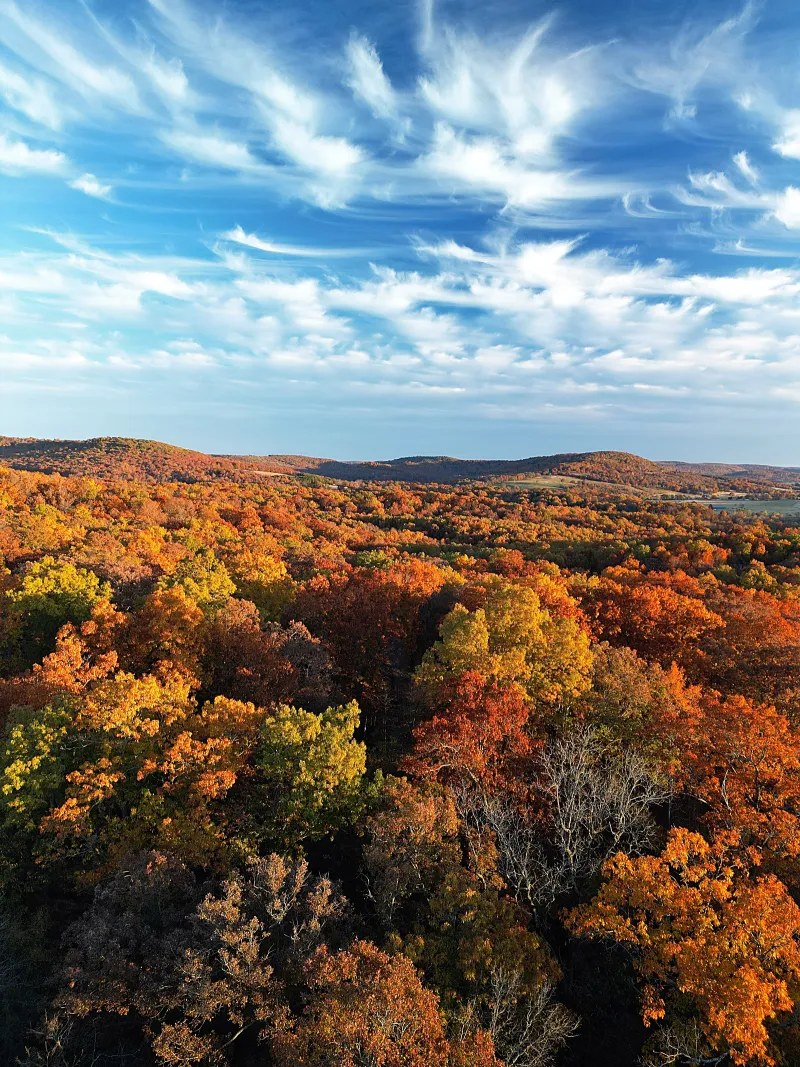
In a typical year the color moves through the woods in a set order. Sassafras, sumac and Virginia creeper turn first, in mid-September; black gum, bittersweet and dogwood follow in late September; and maples, ashes, hickories and oaks peak around mid-October in Missouri, the Missouri Department of Conservation says. In the Arkansas Ozarks, color usually comes on in earnest in the second week of October and peaks in late October, according to Arkansas Tourism, and the color sweeps south through the rest of the state into mid-November.
This year ran late. In reports posted Nov. 5, the Missouri Department of Conservation said its Southwest Region, which includes McDonald and Barry counties along the Arkansas line, was “at peak and even starting to lean past peak,” about three weeks after Missouri’s usual mid-October peak. The department’s Ozark Region report noted that “this October was one of the warmest on record for Missouri” and that many oaks were a dull color this year, and the Southwest report said oaks there were “expected to mostly go brown.” NWA News found no comparable official report for Arkansas this year.
Oaks are often the last to finish, and some never quite let go. Young oaks and lower branches often hold their dead, brown leaves all winter until new buds push them off in spring, a habit called marcescence. Extension scientists have several ideas why, including that the dry leaves discourage deer from browsing twigs and buds, but none is proven.
Arkansas has plenty of leaves to watch. The state is about 55% forest, 18.8 million acres, and oak-hickory forest is the most common type, according to the Arkansas Department of Agriculture’s Forestry Division. The shortleaf pines and eastern red cedars that stay green are what make the reds and golds stand out.
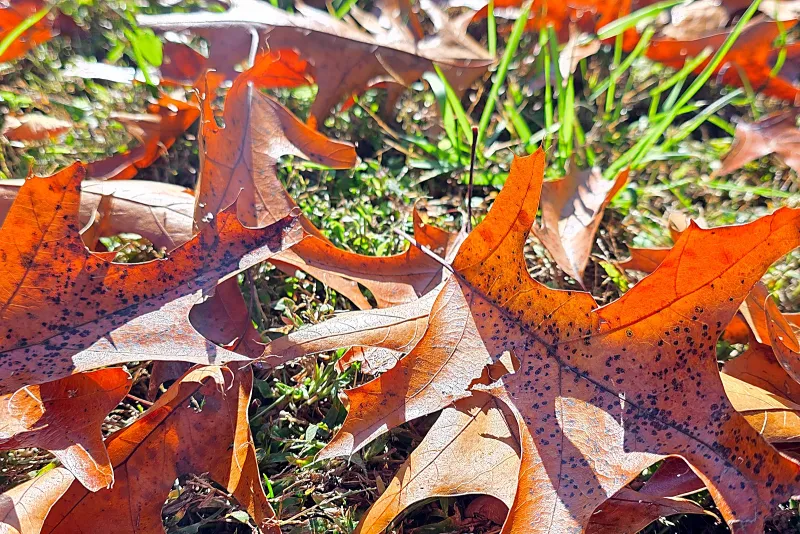
Once the leaves are down, the easiest thing to do is often to leave them. Running a mower over them at its highest setting in a crisscross pattern, twice, chops them small enough to feed the lawn, University of Missouri Extension horticulturist David Trinklein said in October; research shows a layer up to 6 inches thick can be mulched in with no ill effects. Leaves also make good compost and garden mulch. Before burning any, check whether your county is under a burn ban.
Spotted a mistake? Tell us. We fix errors in the open, on the corrections page.